

Praying Like a Child
The Divine Office connects us to a stream of prayer

By Genevieve Kineke
Many decades ago, I committed to praying a portion of the Divine Office. Morning and Evening Prayer are recommended for Benedictine Oblates, and I have always appreciated the larger structure it provides to one’s prayer life. Giving the day to God in the morning, and closing out the day in gratitude is foundational to our faith, and knowing that I’m praying with the Church (even in my paltry way) is deeply consoling.
There have been many “chapters” in this commitment, as I have moved from form to form. I confess that long ago I lost my lovely little Benedictine Office book. Since I was for many years a busy mother, I’ve used various books, as well as websites and podcast resources. The former was great for when I could snatch a little quiet time morning and evening in my Beloved Chair. Online resources worked when driving or chores kept me in motion..
The problem that grew organically from this commitment wasn’t at all associated with any particular form. Rather, it was the Prayer Creep that sprouted around the Office, especially now that I’m widowed and have time for that Beloved Chair. As long as I’m sitting there, why not pray for the clergy? This led to the creation of a list of every priest I’ve known for over forty years. And the intentions! What else have I to do but offer up the myriad intentions of all who entrust them to me. And all those who don’t actually ask me to pray, but I knew they could use prayers. Who doesn’t? And then the needs of the Church, and the world, and this and that ... until those well-meant intentions took twice as long as the Office! It was becoming unwieldy and had to change.
Quite recently, I heard a lovely interview with Dr. Rachel Fulton Brown’s new book on the Little Office of the Blessed Virgin Mary. Her account of the outsized history of this prayer was fascinating, with a sizeable chunk of Christendom (both clergy and lay) praying it daily! Being a history buff, I ordered her book, which turned out to be a hefty tome of almost 500 pages, not counting the 200 pages of footnotes! I’m in Geek heaven!
What this pointy-headed scholarship actually reveals is the profound beauty of the child-like faith of the people whose minds were shaped by simple communal prayers. Their trust in Our Lord’s own Mother sufficed to propel them through hardships that we cannot begin to appreciate from this distance. As sophisticated as we think we are, we must try to imitate their trust. Dr. Brown writes:
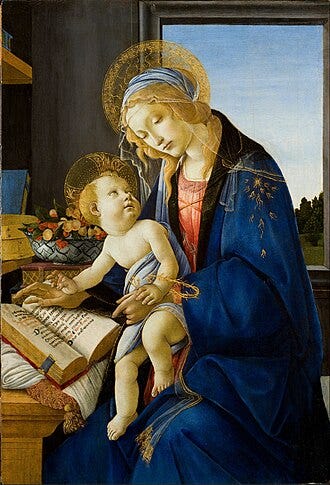
Imagine! Imagine that you are a devotee of Mary and her Son; a medieval devotee of the Virgin, skilled in the recitation of her Office, that cycle of psalms, chants, lessons, and prayers, said daily throughout the High Middle Ages, and later, by every man, woman, or child, who could read, and, as we see, even by many who knew the texts only by heart, or in part. As you sing to her, the chants and psalms of her Office, imagine that you know yourself joined by all the creatures in Heaven and on earth in worship of their Creator, made visible to his creatures through the Incarnation of the Son, and that Lady to whom you sing is the one who made him visible by giving birth to him.
In our fragmented, post-Christian world, we cannot imagine such a community, but it is still ours! When we pray the Divine Office—any version or even a part—we are joined by the multitudes throughout the ages who believed as we do now, and who share the devotion from their beatific reward, so much better even than my Beloved Chair! Just imagine—this is what anchored Christendom for centuries!
The author continues:
“You could never weary of describing her, because she herself is the most perfect image and likeness of the Lord, whom she bore in her womb, the unspotted mirror of his majesty, and the very image of his goodness” (Wisdom 7:26).
How I love my prayers now! Community matters, especially for those living alone or unable to engage with the wider world as they might wish. And as for the focus on Mary that some might question? She is our mother, our model, and our intercessor with the good God. She keeps nothing for herself, but actually echoes the perfect will of God in every cell of her being!
The most surprising aspect of adopting this shorter, more powerful form of prayer is what it has done to the Prayer Creep. When we are joined to the Almighty in this way, feeling our littleness but wanting to join our every inclination to the Divine will, we can present the prayer in its entirety and trust that good will come. (Fiat voluntas tua! Thy will be done!)
It’s like that little boy in 1965, who hugged the Sears catalogue to his chest, and said, “I want the magnifying glass, I want the tent, I want the magician’s set, I want it all!” I still have my list of intentions, but I can simply hug them to my heart (like that catalogue) as I pray the psalms, begging for grace to seep into all the cracks and crevices of the lives of those I love. Surely God knows the details, and in bringing them into the Office I’m joined by all the angels and saints as well.
Isn’t this what Saint Therese of Lisieux wanted? Certainly, each of us has a list of souls that God loves more than we do. Moreover, we have a list of intentions that God promises to fulfill in ways unimagined. Additionally, we have so many apprehensions and outright fears, but God can eradicate them all when the greater good has been achieved. His ways are not our ways, but the desire of his Heart is that the desires of our own hearts nestle inside his with trust—in imitation of Our Lady.
I cannot recommend this prayer enough. Mornings and evenings dedicated to God through the motherhood of the one he entrusted with his very Life will be blessed—and all that happens between. In the Office, we see the ancient promises laid out before us daily. We are swept along into the narrative toward the culmination of the divine plan throughout the ages. It should salve the loneliness, staunch the fears, ease the pain, and lead to a deeper faith as we align our fiat with that of the Blessed Mother: Fiat voluntas tua!
Helpful links:
Universalis offers all the prayers of the Divine Office according to the Novus Ordo calendar.
DivineOffice.org offers all the prayer of the Novus Ordo calendar and offers a community as well.
IBreviary also offers an app for download to Android or iPhone with all the prayers of the Novus Ordo.
The Ordinariate Office cycles through all 150 psalms monthly, with a lovely translation!
The Ordinariate Office is prayed here in community every morning and evening live—all are welcome.
The Little Office of the BVM with prayers in English online according to the Novus Ordo calendar
The Little Office of the BVM according to the Vetus Ordo calendar, English and Latin
The Little Office of the BVM in English and Latin with hymns (I was a sucker for the blue cover!)
Mary and the Art of Prayer: The Hours of the Virgin in Medieval Life and Prayer OK, maybe a little long, but every page is a treasure and offers so much insight into a deeply Christian time
There are many more resources—just do a search and compare sites and books.
If you are already praying the Office or have questions, please comment and we will offer any assistance we can. Most importantly, remember that you are never alone! So many are already praying for your needs and would love for you to join the ongoing choir of praise!
 | A guest post by
|